

The short-term rental market in France spans a wide range of destinations, with significant differences in revenue, occupancy, daily rates, and listing volume across cities. Current 2026 market data highlights the strength of major tourism markets: Paris has 37,919 active listings, while Cannes has 10,143, Nice has 10,917, and Marseille has 8,235. Performance also varies considerably, with Paris generating an average annual revenue of €61,278 at a 72% occupancy rate, while Nice generates €38,463 with 70% occupancy. These differences make market selection a critical factor for investors evaluating short-term rental opportunities in France.
Demand remains strong across France’s leading short-term rental destinations, but performance varies significantly by market. Nice, for example, combines a 70% occupancy rate with an average daily rate of €151 and €38,463 in annual revenue, while Cannes generates €43,790 annually with a 51% occupancy rate. This variation highlights the importance of evaluating local demand, pricing potential, property characteristics, and regulations when selecting a market. For investors and property managers, understanding these market-level differences is essential for identifying opportunities and building an effective short-term rental strategy.
France’s STR Market in 2026: Key Numbers
France remains a highly diverse vacation rental market, with significant differences in short-term rental performance across destinations. Current 2026 data shows that Paris generates an average annual revenue of €61,278 with a 72% occupancy rate, while Cannes reaches €43,790 and Nice generates €38,463 with 70% occupancy. Other major markets include Marseille, with €27,910 in annual revenue and 68% occupancy, and Lyon, with €23,753 and 64% occupancy. These figures highlight the importance of evaluating each city individually, as revenue potential depends on local demand, occupancy, pricing, property characteristics, and market conditions.
Key market indicators for France in 2026:
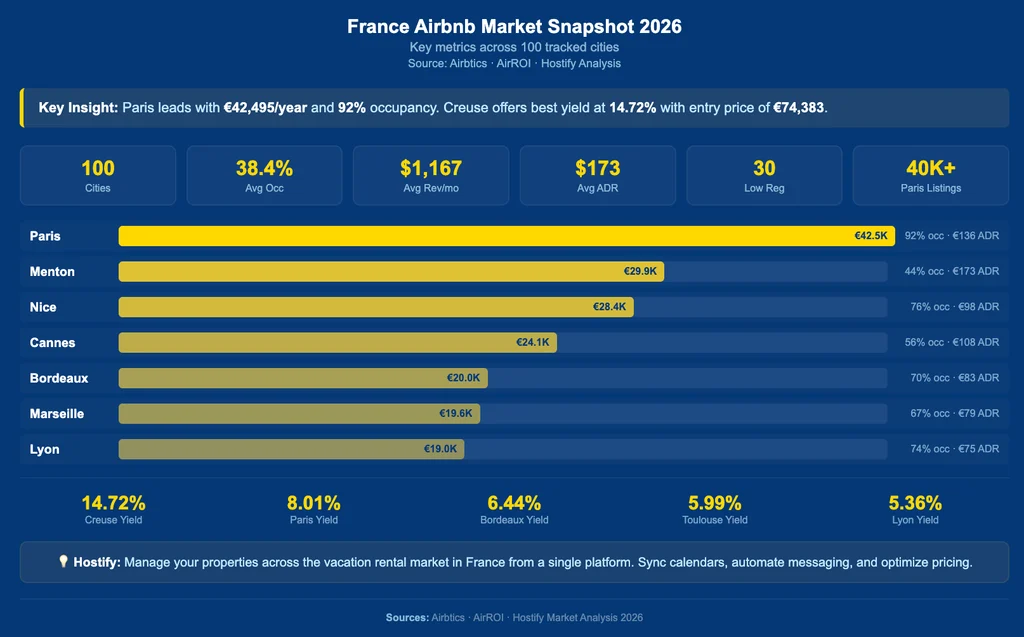
- Occupancy rates range from 41% in Saint Tropez to 92% in Paris, with most major cities operating above 60%.
- Average Daily Rates vary widely, from €59 in Toulouse to €173 in Menton, reflecting the diversity of the French market.
- Gross rental yields are strongest in emerging markets like Creuse at 14.72%, while premium destinations like Paris offer a solid 8.01% yield.
- Entry prices for a one-bedroom apartment start as low as €74,383 in Creuse and reach €766,750 in Saint Tropez, offering options for every budget.
- Top-performing cities like Paris, Nice, and Bordeaux combine high occupancy with strong daily rates, making them reliable choices for investors.
- Emerging markets such as Creuse offer lower entry prices and higher yields, appealing to investors seeking cash flow over capital appreciation.
Top 10 Best Airbnb Cities in France for Investment
When analyzing the best places to invest in Airbnb in France, revenue per listing is the single most telling indicator of a market’s income potential. According to AirROI’s 2026 dataset tracking over 100 cities across France, Saint Martin leads with $3,328 in monthly revenue, followed closely by Chamonix-Mont-Blanc at $2,804 and Paris at $2,777. These top-performing markets share common characteristics: strong tourism demand, premium nightly rates, and in many cases, low regulation profiles that reduce compliance costs. For investors evaluating where to place capital, these cities offer the highest gross returns per property.
Key insights from the Airbnb France top markets:
- Saint Martin generates $3,328 per month with $388 ADR and 43.6% occupancy, ranking first in revenue with low regulation.
- Chamonix-Mont-Blanc follows at $2,804 per month with $361 ADR and 39.3% occupancy, driven by year-round alpine tourism.
- Paris remains the largest market with 40,362 active listings, generating $2,777 per month at 46.6% occupancy and $273 ADR.
- Morzine offers $2,203 per month with $375 ADR and low regulation, making it attractive for investors seeking fewer compliance hurdles.
- Les Belleville delivers $2,029 per month with $302 ADR and 41.1% occupancy in the prestigious Tarentaise Valley.
- Gérardmer, an emerging lakeside destination in the Grand Est, generates $2,010 per month with $228 ADR and moderate regulation.
- Tignes produces $1,981 per month with $268 ADR and 40.3% occupancy, benefiting from both winter and summer tourism.
- Lège-Cap-Ferret on the Atlantic coast earns $1,938 per month with $386 ADR, appealing to premium coastal travelers.
- Megève commands the highest ADR in France at $419 per night, generating $1,931 per month despite lower occupancy.
- Annecy rounds out the top ten with $1,746 per month, $189 ADR, and 44.8% occupancy in a high-regulation but high-demand market.
For property managers looking to maximize returns in these top markets, understanding how to improve Airbnb bookings using property management software can make the difference between a property that performs and one that underperforms.”
Where Are the Most Active Airbnb Markets in France?
Market depth matters. Cities with the highest number of active listings offer more reliable benchmarking data, more comparable properties for pricing, and typically a more liquid resale market. Paris dominates with over 40,000 active listings, more than four times the next largest market. The French Riviera features prominently, with Nice, Marseille, and Cannes all ranking in the top five. For investors, these markets provide the deepest data and the most competitive environment.
| Market | Listings | Revenue/mo | ADR | Occupancy | Reguation | |
| 1 | Paris | 40,362 | $2,777 | $273 | 46.6% | High |
| 2 | Nice | 9,856 | $1,655 | $190 | 45.7% | High |
| 3 | Marseille | 8,767 | $1,245 | $153 | 43.8% | High |
| 4 | Cannes | 8,370 | $1,716 | $304 | 31.6% | High |
| 5 | Lyon | 4,552 | $1,325 | $136 | 43.2% | High |
| 6 | Antibes | 4,196 | $1,465 | $216 | 41.9% | High |
| 7 | Toulouse | 3,878 | $918 | $96 | 43.1% | High |
| 8 | Agde | 3,665 | $662 | $134 | 35.2% | Moderate |
| 9 | Bordeaux | 3,452 | $1,446 | $160 | 42.4% | High |
| 10 | Montpellier | 3,241 | $869 | $109 | 42.6% | High |
Where Do Hosts Earn the Most Revenue?
Revenue is the product of nightly rate and occupancy, capturing the combined effect of both metrics. Saint Martin leads with $3,328 per month, driven by premium pricing of $388 per night. Alpine destinations dominate the top ten, with Chamonix, Morzine, Les Belleville, and Tignes all ranking in the top seven. These markets attract high-spending travelers willing to pay a premium for mountain experiences, making them ideal for investors seeking maximum income per property.
| Market | Revenue/mo | Listings | ADR | Occupancy | Regulation | |
| 1 | Saint Martin | $3,328 | 1,497 | $388 | 43.6% | Low |
| 2 | Chamonix | $2,804 | 2,280 | $361 | 39.3% | High |
| 3 | Paris | $2,777 | 40,362 | $273 | 46.6% | High |
| 4 | Morzine | $2,203 | 1,840 | $375 | 36.2% | Low |
| 5 | Les Belleville | $2,029 | 1,481 | $302 | 41.1% | High |
| 6 | Gérardmer | $2,010 | 1,239 | $228 | 36.5% | Moderate |
| 7 | Tignes | $1,981 | 1,178 | $268 | 40.3% | Moderate |
| 8 | Lège-Cap-Ferret | $1,938 | 1,399 | $386 | 34.6% | High |
| 9 | Megève | $1,931 | 962 | $419 | 30.8% | Low |
| 10 | Annecy | $1,746 | 3,177 | $189 | 44.8% | High |
Where Are the Highest Occupancy Rates?
Occupancy is the demand signal that determines how much of your nightly rate converts to actual income. Paris leads France with 46.6% occupancy, followed closely by Saint-Paul at 45.8% and Nice at 45.7%. Cities with the highest occupancy rates reflect sustained guest demand and lower vacancy risk. For investors prioritizing predictable cash flow and mortgage-backed investments, these markets offer the most stability.
| Market | Occupancy | Listings | Revenue/mo | ADR | Regulation | |
| 1 | Paris | 46.6% | 40,362 | $2,777 | $273 | High |
| 2 | Saint-Paul | 45.8% | 1,646 | $1,646 | $172 | Low |
| 3 | Nice | 45.7% | 9,856 | $1,655 | $190 | High |
| 4 | Rennes | 45.3% | 1,360 | $935 | $91 | High |
| 5 | Strasbourg | 45.1% | 2,655 | $1,565 | $151 | High |
| 6 | Annecy | 44.8% | 3,177 | $1,746 | $189 | High |
| 7 | Angers | 44.5% | 1,157 | $954 | $98 | Moderate |
| 8 | Biarritz | 43.9% | 1,672 | $1,463 | $243 | High |
| 9 | Marseille | 43.8% | 8,767 | $1,245 | $153 | High |
| 10 | Saint Martin | 43.6% | 1,497 | $3,328 | $388 | Low |
For investors targeting high-occupancy markets, improving occupancy using management tools helps maintain consistent bookings and maximize revenue throughout the year.
French Regulations in 2026: What Investors Must Know
The Le Meur Law & Co-Ownership Voting
The Le Meur Law of 2024, which took full effect in 2025 and evolved in 2026, introduced two major changes for co-ownership buildings. First, any co-owner who declares themselves as a tourist furnished rental operator must inform the co-ownership trustee. Second, new co-ownership regulations must explicitly indicate whether tourist furnished rentals are authorized or prohibited. This means that buyers must check the building’s rules before purchasing, as future votes could restrict or ban short-term rental activity.
API Meublés – Automated Enforcement from May 2026
Since May 20, 2026, all short-term rental hosts in France must register their property through the national tele-service apimeubles.finances.gouv.fr. The previous town-hall declaration system is gone, replaced by this single national platform. The system automatically assigns a registration number (NER) and forwards the data to the competent communes.
The rule applies to all rentals, whether primary or secondary residence, and covers hosts on Airbnb, Booking, Abritel, or any other channel. Foreign owners with French properties must also register. The declaration is filed via FranceConnect and takes about 15-20 minutes. The NER is assigned immediately and must be displayed on all listings. Fines for non-compliance are now enforced automatically.
Tax Changes (Micro-BIC) & Energy Rules
The Finance Act for 2025 (LFI 2025) transformed the tax regime for short-term rentals. For unclassified furnished tourist rentals, the micro-BIC allowance drops from 50% to 30%, and the turnover cap falls from €77,700 to €15,000 per year, effective February 2025. For classified rentals, the allowance remains at 50% with a cap of €83,600. This creates a deep divide between the two regimes. An unclassified owner with €14,000 in income now pays tax on €9,800 rather than €7,000 under the old rules.
Receipts below €23,000 per year trigger no URSSAF social contributions. Above this, you may qualify as a Professional Furnished Rental Operator (LMP) with mandatory SSI registration. The CFE business tax is generally due for regular Airbnb rentals. Owners should also monitor the 120-day cap in Paris and secure their registration number. Obtaining official classification is now a fiscal decision, as it preserves access to the 50% allowance and higher cap.
How to Pick the Right French Market for You
No single market fits every investor. The best choice depends on your financial goals, risk tolerance, and operating capacity. Use this framework to match your strategy with the right metrics.
- Predictable cash flow → Focus on occupancy. High occupancy means consistent bookings and lower vacancy risk.
- Maximum income per property → Focus on revenue. Revenue captures the combined effect of rate and occupancy.
- Luxury or premium positioning → Focus on ADR. High-ADR markets reward property upgrades and premium amenities.
- Deep market data and liquidity → Focus on active listings. More listings mean better benchmarking and resale options.
- Always check regulation. Low regulation = faster entry. High regulation = more compliance but may still be profitable.
How Hostify Helps You Manage Your French Short-Term Rental Portfolio
Managing a short-term rental portfolio in France in 2026 means navigating complex regulations, multiple booking platforms, and growing guest expectations. As your portfolio expands, manual processes become a bottleneck. Hostify is an all-in-one property management software designed to help property managers and rental owners automate operations, centralize data, and focus on growth.
- Channel Manager – Distribute and manage all your listings across Airbnb, Booking.com, Vrbo, Expedia, and 400+ channels from one place.
- Unified Inbox – Stop checking multiple inboxes. All guest messages from every platform in one dashboard.
- Automations – Automate repetitive tasks like messaging, reviews, pricing, and payments to save hours every week.
- Multi-Calendar – Unified view of all properties. Perform bulk updates on rates, availability, and minimum stays.
- Booking Website – Get your own free, commission-free direct booking website with Stripe integration.
- Payment Processing & Invoicing – Simplify payments, deposits, and invoicing for guests and owners.
- Mobile App – Manage properties and communicate with guests from anywhere, anytime.
- 24/7 Premium Support – Dedicated Customer Success Manager and real support via phone, email, chat, or video call.
Whether you manage 5 properties in Paris or 50 across the French Riviera and the Alps, Hostify helps you stay compliant, save time, and grow your business.
Frequently Asked Questions About Short-Term Rental Investment in France
Yes. Market data shows strong occupancy rates and revenue growth across multiple French cities.
Paris generates $2,777 per month with 46.6% occupancy, while alpine destinations like Chamonix and Morzine deliver premium returns.
Success depends on selecting the right market, understanding local regulations, and using technology to optimize operations and pricing.
Regulatory changes, seasonal demand fluctuations, and co-ownership voting are the main risks.
The Le Meur Law allows buildings to ban short-term rentals with a two-thirds majority. Stricter tax rules under LFI 2025 have also reduced allowances for unclassified properties.
However, compliant operators who obtain classification and follow local rules continue to profit.
Yes. There are no restrictions for foreign investors purchasing property in France.
You will need a local French bank account, a valid government ID, and cover notaire fees and stamp duty.
A local real estate agent can help navigate the process, and you can complete the purchase by power of attorney from anywhere in the world.
In high-pressure areas like Paris, renting a primary residence is capped at 120 days per calendar year.
This rule does not apply to secondary residences, but those require a change-of-use authorization with compensatory creation of equivalent residential space.
Always verify local rules before purchasing.
Yes. Since May 20, 2026, all short-term rental hosts must register through the national tele-service apimeubles.finances.gouv.fr.
The system assigns a registration number (NER) which must appear on all listings.
Fines for non-compliance are automatically enforced.
Final Take: Is 2026 the Year to Invest in France?
The data tells a clear story. Markets across France show strong demand and revenue potential, from the premium alpine destinations to the high-occupancy urban centers like Paris and Nice. The industry is professionalizing, and operators who treat it as a real business are capturing market share from casual hosts. Regulation is reshaping the landscape, but compliant operators who obtain classification and follow the new rules can still generate strong returns.
For those considering a short-term rental investment in France in 2026, the fundamentals remain solid. Travel demand is resilient, and guests continue to choose vacation rentals over traditional hotels for flexibility, privacy, and unique experiences. However, manual processes that worked for five properties will not work for fifty. Having the right technology partner is essential to scale efficiently, stay compliant, and maximize revenue across your portfolio. Hostify helps property managers automate operations, centralize data, and focus on growth. Book a demo today and discover how Hostify can help you manage, automate, and grow your business in France.