

The peer-to-peer tourist accommodation market in South America is still in its early stages of development, with significant room for growth compared to mature destinations in Europe and North America. According to academic research analyzing Airbnb data from four major Latin American cities, Buenos Aires, Mexico City, Rio de Janeiro, and Santiago, the market shows relatively modest penetration, ranging from 0.8 to 2.7 listings per 1,000 inhabitants. This is considerably lower than European cities like Paris at 8.0 or Barcelona at 6.7, indicating a wide margin for continued expansion.
For investors considering vacation rentals in South America, the region offers compelling opportunities. Research reveals that demand is highly concentrated, with 20 percent of accommodations absorbing up to 90 percent of guest reviews in cities like Rio de Janeiro and Santiago. This concentration suggests that professionally managed properties with strong guest experiences can capture outsized market share. Additionally, studies indicate that hosts in South American markets are not yet fully optimizing their pricing strategies, which creates an opportunity for operators who leverage technology to maximize revenue.
Why Invest in Vacation Rentals in South America in 2026?
The short-term rental market in South America is experiencing significant growth, with platforms like Airbnb expanding rapidly across the region. In Chile alone, Airbnb has approximately 27,400 active hosts nationwide, with annual growth rates generally exceeding 50 percent in various cities. Research from Valparaíso reveals that the platform operates across diverse urban contexts, from heritage tourism zones to working-class neighborhoods, indicating a broad and resilient demand base that extends beyond traditional tourist areas.
Key investment drivers:
- High demand concentration creates opportunity for professional operators. Research shows that in cities like Rio de Janeiro and Santiago, 20 percent of accommodations absorb up to 90 percent of guest reviews, meaning professionally managed properties can capture significant market share.
- Dual market structure provides multiple entry points. In Valparaíso, private rooms represent 49.5 percent of listings while entire homes account for 48.5 percent, demonstrating that investors can choose between lower-cost room rentals or higher-yield entire properties depending on their capital and strategy.
- Untapped pricing potential exists across markets. Studies indicate that hosts in South American cities are not fully optimizing their pricing strategies, creating an opportunity for investors who use data-driven tools to maximize revenue per listing. For a complete guide on managing properties remotely and using technology to automate daily operations, check out How to Manage Your Airbnb Remotely.
- Nightly rates can exceed citywide averages by three times. In heritage and coastal zones with panoramic views, premium listings command significantly higher prices, with maximum rates reaching up to USD 442 per night in some Valparaíso neighborhoods.
- Regulatory gaps favor early movers. Unlike mature European markets with strict short-term rental restrictions, many South American cities lack comprehensive regulation, allowing investors to establish positions before formal frameworks are implemented.
Top 10 South American Countries for Airbnb Investment (2026 Data)
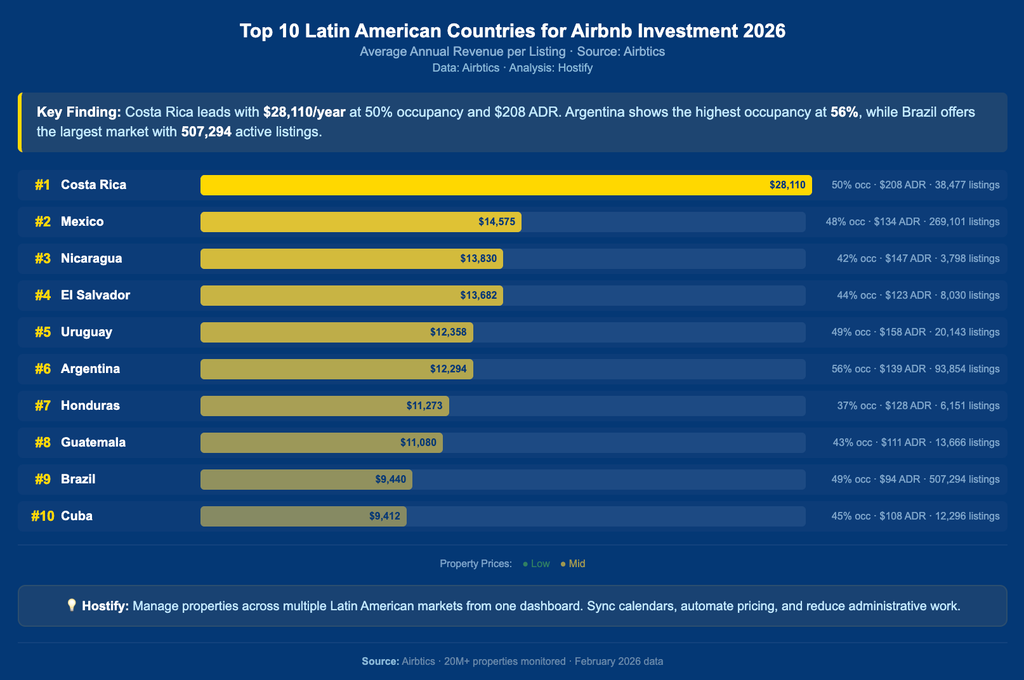
According to Airbtics data, Costa Rica leads the Latin American market with average annual Airbnb income of $28,110, followed by Mexico at $14,575 and Nicaragua at $13,830. Argentina stands out with the highest occupancy rate at 56 percent, while Brazil dominates in scale with over 500,000 active listings. The table below ranks the top 10 countries by annual revenue per listing, showing the full picture of income potential across the region.
Beyond the Numbers: 10 Undervalued Cities Worth Watching
Beyond the top country rankings, specific cities across South America offer compelling opportunities for investors seeking strong returns in the vacation rentals in South America market. These cities combine high occupancy rates, solid revenue potential, and favorable local conditions that make them worth watching. The list below is based on median monthly revenue data from TuLugar, which analyzes entire-home Airbnb listings across Latin America with at least 100 properties per city.
Vacation Rentals in Punta del Este, Uruguay
Punta del Este leads Latin America in monthly revenue for entire-home Airbnbs. The city generates $1,639 in median monthly revenue with a 50 percent occupancy rate and a $99 average nightly rate.
- Highest revenue: $1,639 median monthly income per listing, the highest in the region
- Premium rates: $99 average nightly rate
- Established market: 923 active listings, indicating a mature tourism ecosystem
- Seasonal premium: Luxury coastal destination attracting affluent visitors from across the Americas
Vacation Rentals in Cartagena, Colombia
Cartagena combines cultural tourism with strong short-term rental performance. The city generates $1,458 in median monthly revenue with 65 percent occupancy and a $72 average nightly rate.
- Strong monthly income: $1,458 median monthly revenue per listing
- Cultural appeal: Historic walled city attracts international travelers
- Growing demand: 187 active listings analyzed with stable occupancy
- Premium positioning: High ADR compared to other Colombian markets
Vacation Rentals in Montevideo, Uruguay
Montevideo offers a stable and consistent short-term rental market with strong occupancy. The city generates $1,210 in median monthly revenue with 63 percent occupancy and a $63 average nightly rate.
- Balanced performance: $1,210 monthly revenue with strong 63% occupancy
- Large market: 974 active listings providing good benchmarking data
- Stable demand: Scores 98 out of 100 on AirDNA’s seasonality scale, indicating steady year-round bookings
- Business and leisure mix: Capital city attracting both tourists and business travelers
Vacation Rentals in San Bernardino, Paraguay
San Bernardino has emerged as a high-yield market with attractive returns and minimal regulatory burden. The city generates $1,134 in median monthly revenue with 47 percent occupancy and a $78 average nightly rate.
- Strong income: $1,134 median monthly revenue per listing
- Premium rates: $78 average nightly rate, among the highest in Paraguay
- Low regulation: No restrictive short-term rental rules compared to other South American markets
- Growing popularity: Increasing interest from both domestic and international travelers
Vacation Rentals in Valparaíso, Chile
Valparaíso offers a unique heritage tourism market with solid revenue potential. The city generates $1,042 in median monthly revenue with 57 percent occupancy and a $57 average nightly rate.
- Heritage appeal: UNESCO World Heritage site attracting cultural tourists
- Dual market structure: Mix of entire homes and private rooms creates multiple entry points
- Growing demand: Expanding tourism infrastructure and international visibility
- Diverse offering: Properties range from historic hillside homes to modern coastal apartments
Vacation Rentals in Rio de Janeiro, Brazil
Rio de Janeiro remains one of Brazil’s largest and most dynamic short-term rental markets. The city generates $1,040 in median monthly revenue with 70 percent occupancy and a $51 average nightly rate.
- High occupancy: 70% annual occupancy, one of the highest in the region
- Massive market: Over 2,000 active listings providing deep data and liquidity
- Year-round demand: Scores 98 out of 100 on AirDNA’s seasonality scale, indicating steady bookings across the year
- Global brand: Iconic destination attracting international visitors year-round
Vacation Rentals in Ñuñoa, Chile
Ñuñoa stands out for exceptional occupancy rates that make it one of the most consistent performers. The city achieves 83 percent occupancy, generating $984 in median monthly revenue with a $41 average nightly rate.
- Highest occupancy: 83% occupancy, among the highest tracked across Latin America
- Consistent income: $984 median monthly revenue per listing
- Urban location: Affluent neighborhood in Santiago with stable demand from business and leisure travelers
- Reliable bookings: High occupancy translates to predictable cash flow and lower vacancy risk
Vacation Rentals in Mendoza, Argentina
Mendoza offers a growing wine tourism market with strong revenue potential. The city generates $983 in median monthly revenue with 68 percent occupancy and a $50 average nightly rate.
- Tourism growth: Increasing popularity among international travelers seeking wine experiences
- High occupancy: 68% annual occupancy, well above the regional average
- Premium positioning: Attracts higher-spending travelers in the wine tourism segment
- Seasonal stability: Diversified demand across wine harvest and adventure tourism seasons
Vacation Rentals in Comuna 14 – El Poblado, Colombia
El Poblado is Medellín’s most sought-after neighborhood for short-term rentals, attracting digital nomads and tourists. The area generates $952 in median monthly revenue with 70 percent occupancy and a $47 average nightly rate.
- Digital nomad hub: Strong demand from remote workers seeking extended stays
- High occupancy: 70% annual occupancy, indicating consistent demand
- Premium location: Most desirable neighborhood in Medellín for international visitors
- Growing market: Medellín has over 12,000 active Airbnb listings with 63% occupancy
Vacation Rentals in Ciudad del Este, Paraguay
Ciudad del Este offers an emerging market opportunity with solid revenue potential. The city generates $910 in median monthly revenue with 68 percent occupancy and a $50 average nightly rate.
- Strong occupancy: 68% annual occupancy, well above the regional average
- Growing market: Increasing tourism infrastructure and international connectivity
- Low entry costs: Attractive property prices compared to more established markets
- Nearby attractions: Proximity to Iguazu Falls, one of South America’s top tourist destinations
Key Regulations for Foreign Investors
According to a Bloomberg Línea analysis of regulatory trends across Latin America, short-term rental platforms like Airbnb are legal in most countries, but governments are moving toward stricter formalization and control measures. Juan Camilo Vargas, executive director of the Colombian Association of Digital Platform Tourism Service Providers (Asohost), identifies five regulatory trends that could impact short-term rental investors across the region.
Key regulatory trends across Latin America:
- Tourist registration hardening: Several countries are converting tourism registries into “enabling licenses” with multiple technical, urban, and administrative requirements. Colombia is currently debating a decree that would strengthen formalization controls, which Vargas warns could turn registration “from a formalization mechanism into an entry barrier that excludes small providers.”
- Mandatory visible registration on platforms: A growing regional trend requires each listing to display a registration number. This measure can be positive if registration is simple and digital, but poorly designed systems risk creating mass blockages and encouraging informality.
- Territorial operating limits: Cities under housing pressure are discussing limits by nights, zones, or density. “The trend is not to prohibit, but to restrict in a localized manner,” Vargas notes, warning against imposing general limits without impact analysis.
- Traceability and data exchange: Governments across the region are seeking more operational data through digital platforms. This can improve oversight if used with risk criteria and due process, but could become an automatic sanction mechanism if poorly applied.
- Tax collection automation: The region is moving toward taxes collected or withheld directly on platforms. Asohost supports tax payment as long as mechanisms are clear, viable, and proportional.
Country-specific regulatory landscapes:
| Country | Legal Status | Key Requirements |
| Colombia | Legal | National Tourism Registry (RNT) registration; property horizontal regulation authorization; 0.25% parafiscal contribution; guest registry and reporting; safety and quality standards |
| Mexico | Legal nationwide | Stricter in Mexico City with mandatory registration and some operating limits |
| Brazil | Legal | Territorial regulation (no specific national framework); requirements defined by local authorities |
| Chile | Legal | Less tourism registry-focused; governed by co-ownership rules and tax compliance, especially VAT on furnished habitual rentals |
| Argentina | Legal | Local regulation significant in Buenos Aires (Law 6,255) requiring registration and licensing |
| Peru | Legal | Subject to tourism regulations and specific local/municipal requirements; moving toward digital registration schemes |
“Short-term rentals offered through digital platforms are legal in the vast majority of Latin American countries, although with different degrees of specific regulation,” explains Esteban Garcia Jimeno, senior counsel at Holland & Knight.
How to Choose the Right Market for Your Strategy
No single market fits every investor. The best choice for your vacation rentals in South America depends on your financial goals, risk tolerance, and operating capacity. Use this framework to match your strategy with the right metrics.
- Predictable cash flow → Focus on occupancy: High occupancy means consistent bookings and lower vacancy risk. Providencia leads with 90 percent occupancy, followed by Santiago at 81 percent and Buenos Aires at 73 percent.
- Maximum income per property → Focus on revenue: Revenue captures the combined effect of rate and occupancy. Costa Rica leads with $28,110 per year, followed by Mexico at $14,575 and Nicaragua at $13,830.
- Luxury or premium positioning → Focus on ADR: High ADR markets reward property upgrades and premium amenities. Uruguay commands $154 per night, followed by Colombia at $96 and Brazil at $90.
- Scalability and liquidity → Focus on active listings: More listings mean better benchmarking and resale options. Brazil leads with 9,226 active listings, followed by Argentina with 7,931 and Colombia with 4,847.
- Lower entry costs → Focus on property prices: Countries like Nicaragua, Guatemala, and El Salvador offer low property prices with competitive income potential.
- Favorable regulation → Focus on markets with clear rules: Paraguay offers minimal restrictive regulation, while Colombia and Argentina have established frameworks.
- Always check local regulations: Verify local registration requirements, zoning restrictions, and tax obligations before purchasing. For additional guidance on streamlining your property management operations across multiple markets, check out How Does a Channel Manager Work? Step by Step.
How Hostify Helps You Manage Your South American Vacation Rental Portfolio
Managing a short-term rental portfolio in South America means navigating multiple booking platforms, complex regulations, and growing guest expectations. As your portfolio expands, manual processes become a bottleneck. Hostify is an all-in-one property management software designed to help property managers automate operations and focus on growth. With features like a unified inbox, multi-calendar, and direct booking website, Hostify simplifies daily operations and reduces administrative work.
Whether you manage 5 properties in Buenos Aires or 50 across the Riviera Maya and Santiago, Hostify helps you stay compliant, save time, and grow your business. The platform integrates with over 400 channels, offers payment processing, and provides 24/7 premium support. Book a demo today and discover how Hostify can help you manage, automate, and grow your short-term rental business in South America.
Frequently Asked Questions About Short-Term Rental Investment in South America
Property tax rates vary significantly across South America. Brazil charges an annual property tax of 0.3% to 1.5%, while Chile ranges from 0.98% to 1.4%. Costa Rica offers a lower rate at approximately 0.25% of property value.
These taxes are typically calculated on the property’s assessed or cadastral value, so investors should consult local advisors for precise figures in their target market.
Yes, several countries offer residency pathways for real estate investors. Paraguay recently launched the “Paraguay Investor Pass” program, granting permanent residency with a minimum investment of $200,000 in real estate.
This program bypasses the temporary residency stage and offers reduced dividend tax rates. Argentina is expected to launch a similar program in 2026. Brazil, Uruguay, and other countries also offer residency options, though requirements vary.
South America’s seasons are opposite to North America. Peak summer runs from December to February, ideal for beach destinations and Patagonia.
The dry season (May to October) is best for trekking in the Andes and exploring Peru, Bolivia, and Chile. Shoulder seasons (March to May and September to November) offer milder weather with fewer crowds and are often the best time for city visits.
Yes, financing options exist, though terms vary. In Costa Rica, local banks offer mortgages to foreigners with interest rates between 7.5% and 10%, typically financing 60% to 70% of the property value.
Private lending options are also available for faster closings at higher rates. Many investors use home equity loans from their home countries to pay cash in South America, often securing better terms. Each country has different requirements regarding tax IDs and documentation.
Final Take: Is 2026 the Year to Invest in South America?
Yes. The data is clear: markets across South America show strong demand and revenue potential, from Costa Rica generating $28,110 annually to Argentina achieving the highest occupancy at 56 percent. The industry is professionalizing, and operators who treat it as a real business are capturing market share from casual hosts.
Regulation is evolving across the region with new registration requirements and local limits, but compliant operators who understand the rules and register their properties can still generate strong returns.
Travel demand remains resilient, with digital nomads and international visitors flocking to cities like Medellín, Buenos Aires, and Santiago. Low entry costs, favorable exchange rates, and flexible regulatory environments in many countries create unique opportunities for investors. However, manual processes that worked for one property will not work for ten. Having the right technology partner is essential for scaling efficiently, staying compliant, and maximizing revenue across your portfolio.
Hostify helps property managers automate operations, centralize data, and focus on growth. Book a demo today and discover how Hostify can help you manage, automate, and grow your short-term rental business in South America.