

Spain remains one of Europe’s most powerful magnets for tourists and investors alike. In 2024, the country welcomed over 138 million international arrivals, cementing its position as the top destination in Europe. For property investors, this translates into one thing: consistent demand for vacation rentals in Spain.
But not all cities deliver the same returns. Some markets offer high occupancy year-round, others command premium nightly rates, and a few combine both. The key is knowing where to look and understanding the rules before you buy. This guide breaks down Spain’s top cities for short-term rental investment in 2026, with real data and practical insights to help you make a confident decision.
Spain’s STR Market in 2026: Key Numbers
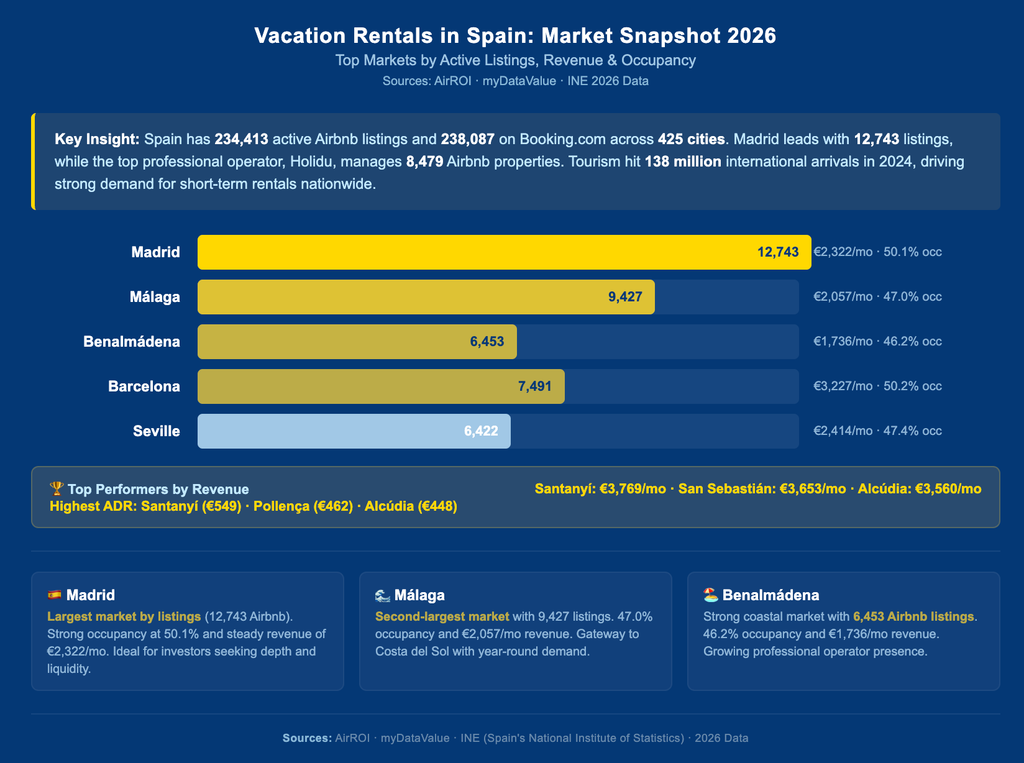
Spain’s short-term rental market has matured into one of Europe’s most dynamic investment landscapes. With over 234,000 active Airbnb listings and 238,000 on Booking.com, the country offers unparalleled depth across 425 cities. Madrid leads as the largest market with 12,743 Airbnb listings, followed closely by Málaga (9,427) and Benalmádena (6,453).
Barcelona, despite tighter regulations, still holds 7,491 active listings, while Seville rounds out the top five with 6,422. The market is increasingly professionalized: the top operator, Holidu, manages over 8,400 Airbnb listings and nearly 11,000 on Booking.com, signaling a clear shift toward corporate management.
For investors evaluating vacation rentals in Spain, this scale means reliable benchmarking data, competitive pricing intelligence, and a mature ecosystem where professional operators are capturing market share from casual hosts.
To navigate these opportunities successfully, property managers can benefit from understanding how to improve Airbnb bookings using property management software, which helps automate rates and maximize revenue across different markets
Top 10 Best Airbnb Cities in Spain for Investment
When evaluating vacation rentals in Spain, revenue per listing is the single most telling indicator of a market’s income potential. According to AirROI 2026 data, Santanyí in the Balearic Islands leads with an impressive $3,769 in monthly revenue, followed by San Sebastián ($3,653) and Alcúdia ($3,560). These top-performing markets share common characteristics: strong tourism demand, premium nightly rates, and sustained occupancy throughout the year. While Barcelona and Madrid generate solid returns with high occupancy rates above 50%, the highest revenue markets are concentrated in the Balearic Islands and along the northern coast, where travelers pay a premium for coastal and cultural experiences.
| Rank | Market | Monthly Revenue | Active Listings | ADR | Occupancy |
| 1 | Santanyí, Balearic Islands | $3,769 | 740 | $549 | 44.3% |
| 2 | San Sebastián, Basque Country | $3,653 | 1,323 | $314 | 45.1% |
| 3 | Alcúdia, Balearic Islands | $3,560 | 1,151 | $448 | 43.4% |
| 4 | Pollença, Balearic Islands | $3,387 | 1,512 | $462 | 44.0% |
| 5 | Palma, Balearic Islands | $3,245 | 960 | $330 | 46.1% |
| 6 | Barcelona, Catalonia | $3,227 | 11,251 | $244 | 50.2% |
| 7 | Yaiza, Canary Islands | $2,616 | 1,440 | $314 | 46.0% |
| 8 | Seville, Andalusia | $2,414 | 7,247 | $193 | 47.4% |
| 9 | Adeje, Canary Islands | $2,409 | 2,821 | $234 | 46.2% |
| 10 | Marbella, Andalusia | $2,369 | 5,413 | $362 | 37.7% |
Source: AirROI, Full-Year 2025 Data
Where Are the Most Active Airbnb Markets in Spain?
Market depth matters for investors. Cities with the highest number of active listings offer more reliable benchmarking data, more comparable properties for pricing, and typically a more liquid resale market. According to AirROI 2026 data, Madrid dominates with 16,423 active listings, more than any other Spanish city. Barcelona follows with 11,251 listings, while Málaga ranks third with 8,649. The Andalusian region features prominently, with Seville (7,247) and Marbella (5,413) showing strong market depth. For investors evaluating vacation rentals in Spain, these markets provide the deepest data and the most competitive environment.
| Rank | Market | Active Listings | Monthly Revenue | ADR | Occupancy |
| 1 | Madrid, Community of Madrid | 16,423 | $2,322 | $183 | 50.1% |
| 2 | Barcelona, Catalonia | 11,251 | $3,227 | $244 | 50.2% |
| 3 | Málaga, Andalusia | 8,649 | $2,057 | $189 | 47.0% |
| 4 | Seville, Andalusia | 7,247 | $2,414 | $193 | 47.4% |
| 5 | Valencia, Valencian Community | 6,931 | $1,783 | $162 | 46.7% |
| 6 | Marbella, Andalusia | 5,413 | $2,369 | $362 | 37.7% |
| 7 | Alicante, Valencian Community | 3,522 | $1,399 | $153 | 43.8% |
| 8 | Torrevieja, Valencian Community | 3,241 | $769 | $127 | 38.3% |
| 9 | Granada, Andalusia | 3,202 | $1,471 | $143 | 42.0% |
| 10 | Arona, Canary Islands | 3,148 | $1,634 | $157 | 46.4% |
Source: AirROI, Full-Year 2025 Data
Where Do Hosts Earn the Most Revenue?
Revenue is the product of nightly rate and occupancy, capturing the combined effect of both metrics. According to AirROI 2026 data, Santanyí leads with $3,769 in monthly revenue, driven by a premium $549 ADR and 44.3% occupancy. The Balearic Islands dominate the top rankings, with four markets in the top ten generating over $3,200 monthly. Barcelona stands out as the only major urban center in the top ten, with $3,227 in monthly revenue from over 11,000 active listings. These markets attract high-spending travelers willing to pay a premium for coastal and island experiences, making them prime targets for vacation rentals in Spain.
| Rank | Market | Monthly Revenue | Active Listings | ADR | Occupancy |
| 1 | Santanyí, Balearic Islands | $3,769 | 740 | $549 | 44.3% |
| 2 | San Sebastián, Basque Country | $3,653 | 1,323 | $314 | 45.1% |
| 3 | Alcúdia, Balearic Islands | $3,560 | 1,151 | $448 | 43.4% |
| 4 | Pollença, Balearic Islands | $3,387 | 1,512 | $462 | 44.0% |
| 5 | Palma, Balearic Islands | $3,245 | 960 | $330 | 46.1% |
| 6 | Barcelona, Catalonia | $3,227 | 11,251 | $244 | 50.2% |
| 7 | Yaiza, Canary Islands | $2,616 | 1,440 | $314 | 46.0% |
| 8 | Seville, Andalusia | $2,414 | 7,247 | $193 | 47.4% |
| 9 | Adeje, Canary Islands | $2,409 | 2,821 | $234 | 46.2% |
| 10 | Marbella, Andalusia | $2,369 | 5,413 | $362 | 37.7% |
Where Are the Highest Occupancy Rates?
Occupancy is the demand signal that determines how much of your nightly rate converts to actual income. l’Hospitalet de Llobregat leads Spain with 52.4% occupancy, followed closely by Tías in the Canary Islands at 50.9% and Barcelona at 50.2%. Madrid (50.1%) and Teguise (49.7%) round out the top five. The Canary Islands dominate the occupancy rankings, with six markets in the top twenty, reflecting sustained guest demand and lower vacancy risk year-round. For investors prioritizing predictable cash flow, these high-occupancy markets offer the most stability for vacation rentals in Spain.
| Rank | Market | Occupancy | Active Listings | Monthly Revenue | ADR |
| 1 | l’Hospitalet de Llobregat, Catalonia | 52.4% | 853 | $2,300 | $174 |
| 2 | Tías, Canary Islands | 50.9% | 1,538 | $2,181 | $216 |
| 3 | Barcelona, Catalonia | 50.2% | 11,251 | $3,227 | $244 |
| 4 | Madrid, Community of Madrid | 50.1% | 16,423 | $2,322 | $183 |
| 5 | Teguise, Canary Islands | 49.7% | 1,235 | $1,743 | $157 |
| 6 | Seville, Andalusia | 47.4% | 7,247 | $2,414 | $193 |
| 7 | Málaga, Andalusia | 47.0% | 8,649 | $2,057 | $189 |
| 8 | Valencia, Valencian Community | 46.7% | 6,931 | $1,783 | $162 |
| 9 | Arona, Canary Islands | 46.4% | 3,148 | $1,634 | $157 |
| 10 | Benalmádena, Andalusia | 46.2% | 2,993 | $1,736 | $189 |
For investors targeting high-occupancy markets like the Canary Islands and Barcelona, learning how to manage your Airbnb remotely with the right tools helps maintain consistent bookings and maximize revenue throughout the year.”
Spanish Regulations in 2026: What Investors Must Know
The New Nationwide Short-Term Rental Law (Effective July 2025)
Important context: The national law introduced in July 2025 was declared null and void by Spain’s Supreme Court on May 21, 2026. The court found that the central government overstepped its constitutional authority by creating a national registry that ran parallel to existing regional systems.
What the original law required (now void):
- Mandatory NRUA (Número de Registro de Alquiler) registration number for all short-term rental properties
- Annual VUDA reporting of guest stays, dates, and booking purposes
- Platform obligation to verify and display registration numbers
- Risk of listing removal and fines for non-compliance
Current status (post-May 2026):
- No national registration number is required
- No annual VUDA report obligation
- Properties removed from platforms for missing NRUA may have grounds to dispute removal
- Regional tourism licenses remain valid and are now the primary regulatory reference
What remains unchanged:
- Regional tourist licenses (VFT in Andalusia, equivalent in other regions) are still mandatory
- Platforms continue to share rental activity data with authorities
- Tax obligations via Modelo 210 remain in place
- Community of owners approval remains critical
Regional & Local Restrictions
With the national registry annulled, Spain’s 17 autonomous communities retain authority over short-term rental regulation. Requirements vary significantly by region.
Andalucía (VFT – Vivienda con Fines Turísticos):
- Mandatory registration with the Andalusian Tourism Registry via sworn declaration (declaración responsable)
- Property must meet minimum standards: 14m² per guest, 25m² minimum total, climate control, ventilation, first aid kit, 24-hour emergency contact
- VFT number must appear in all advertising and platform listings
- Operating without VFT registration triggers fines and tax assessments
Community of Owners (Comunidad de Propietarios):
- Since 2019, communities can vote to prohibit or restrict tourist rentals
- Requires 3/5 majority in a community meeting to block VFT use
- This is often the most critical factor; a community ban can make a tourist rental business plan impossible
- Must review community statutes before purchasing property for rental purposes
Municipal Restrictions:
- Many municipalities have created “containment zones” or caps on licenses
- Barcelona has announced STR licenses will not be renewed beyond 2028
- Local governments can impose additional zoning and saturation-based restrictions
Key practical takeaway: Your regional registration number is now the primary valid reference for operating a legal short-term rental in Spain. Investors must verify both regional licensing requirements and community approval before purchasing property.
Tax Implications for Short-Term Rental Operators
Income Tax (IRNR – Non-Resident Income Tax via Modelo 210):
- EU/EEA residents pay 19% on net rental income (after allowable deductions)
- Non-EU residents pay 24% and may deduct expenses following recent case law (the State may appeal this to the Supreme Court)
- Resident owners taxed at progressive IRPF scale (19%-47%) without the 90% reduction available for long-term rentals
- Quarterly filing deadlines: 1-20 April, July, October, January
New Expense Documentation Requirements (from 2027):
- New annex requiring detailed breakdown of deductible expenses (maintenance, repairs, community fees, utilities, insurance)
- Each deduction must be supported by specific invoices with proper documentation
- Failure to provide detailed breakdowns may result in rejected filings or automatic penalties
Value Added Tax (VAT) – Proposed Changes (pending approval):
- Current system: Most short-term rentals without hotel-style services are exempt from VAT; those with services pay 10%
- Proposed change (Royal Decree expected July 2026): Standard 21% VAT rate for all tourist apartments—higher than hotels (which retain reduced rates)
- This measure is designed to favor the hotel sector and would reduce net profitability for property owners
- Does not affect traditional long-term rentals
Property Taxes:
- IBI (Municipal Property Tax): Annual tax based on cadastral value (varies by municipality)
- Imputed income: If property is kept for personal use and not rented, must declare 2% (or 1.1%) of cadastral value as imputed income
How to Pick the Right Spanish Market for You
No single market fits every investor. The best choice for your vacation rentals in Spain depends on your financial goals, risk tolerance, and operating capacity. Use this framework to match your strategy with the right metrics.
Predictable Cash Flow → Focus on Occupancy
High occupancy means consistent bookings and lower vacancy risk. These markets offer the most stable demand, ideal for investors relying on rental income to cover mortgage payments.
- l’Hospitalet de Llobregat – 52.4% occupancy
- Tías, Canary Islands – 50.9% occupancy
- Barcelona – 50.2% occupancy
- Madrid – 50.1% occupancy
- Teguise, Canary Islands – 49.7% occupancy
Maximum Income per Property → Focus on Revenue
Revenue captures the combined effect of nightly rate and occupancy. These markets deliver the highest gross returns, perfect for investors seeking maximum yield from each property.
- Santanyí, Balearic Islands – $3,769/month
- San Sebastián – $3,653/month
- Alcúdia, Balearic Islands – $3,560/month
- Pollença, Balearic Islands – $3,387/month
- Palma, Balearic Islands – $3,245/month
Luxury or Premium Positioning → Focus on ADR
High-ADR markets reward property upgrades, professional photography, and premium amenities. These destinations attract high-spending travelers willing to pay top dollar.
- Santanyí, Balearic Islands – $549/night
- Pollença, Balearic Islands – $462/night
- Alcúdia, Balearic Islands – $448/night
- Begur, Catalonia – $373/night
- Marbella, Andalusia – $362/night
Deep Market Data & Liquidity → Focus on Active Listings
More listings mean better benchmarking, more comparable properties for pricing, and typically a more liquid resale market. These markets offer the deepest data and most competitive environment.
- Madrid – 16,423 listings
- Barcelona – 11,251 listings
- Málaga – 8,649 listings
- Seville – 7,247 listings
- Valencia – 6,931 listings
Always Check Regulation
All Spanish markets currently have strict regulation. Verify local licensing requirements and community approval before purchasing.
- Regional tourist license (VFT in Andalusia, or equivalent) is mandatory
- Community of owners must approve tourist use (3/5 majority may block rentals)
- Some municipalities have containment zones or license caps
- Barcelona will not renew STR licenses beyond 2028
How Hostify Helps You Manage Your Spanish Short-Term Rental Portfolio
Managing a short-term rental portfolio in Spain in 2026 means navigating complex regional regulations, multiple booking platforms, and growing guest expectations. As your portfolio expands, manual processes become a bottleneck.
Hostify is an all-in-one property management software designed to help property managers and rental owners automate operations, centralize data, and focus on growth. Whether you manage 5 properties in Madrid or 50 across the Costa del Sol and the Balearic Islands, Hostify helps you stay compliant, save time, and grow your business.
With Hostify, you can distribute and manage all your vacation rentals in Spain across Airbnb, Booking.com, Vrbo, Expedia, and 400+ channels from one place. The unified inbox consolidates all guest messages, while automations handle repetitive tasks like messaging, reviews, pricing, and payments. The multi-calendar gives you a unified view of all properties with bulk updates on rates and availability.
You also get your own free, commission-free direct booking website with Stripe integration, plus a mobile app to manage properties and communicate with guests from anywhere. Book a demo today and discover how Hostify can help you manage, automate, and grow your short-term rental business in Spain.
Frequently Asked Questions About Short-Term Rental Investment in Spain
Yes. Markets like Santanyí generate $3,769 in monthly revenue, while Barcelona and Madrid maintain occupancy above 50%. The Supreme Court annulled the national registry in May 2026, reducing bureaucracy.
However, regional licenses and community approval remain essential. Profitability depends on choosing the right market and staying compliant.
Regulatory changes, community bans, and seasonal demand fluctuations are the main risks. The May 2026 Supreme Court ruling removed national registration, but regional rules vary. Some municipalities have license caps, and Barcelona will not renew STR licenses beyond 2028.
Community of owners can also block tourist rentals with a 3/5 majority vote.
Yes. There are no restrictions for foreign investors purchasing property in Spain. Non-resident owners need a Spanish NIE (tax identification number). If residing outside the EU, you may require a fiscal representative.
A local lawyer can help navigate regional licensing and community approval requirements.
The national NRUA registration number introduced in July 2025 was annulled by the Supreme Court on May 21, 2026. It no longer exists.
Instead, you must obtain the regional tourist license applicable to your property’s location (VFT in Andalusia, or equivalent in other regions). This is now the primary valid reference for operating a legal short-term rental.
Yes, but not a national one. You must hold a valid regional tourist license (such as VFT in Andalusia) and display it on all platform listings.
Regional licenses are mandatory and enforced by each autonomous community. Properties without proper regional registration face fines and removal from platforms like Airbnb and Booking.com.
Final Take: Is 2026 the Year to Invest in Spain?
Yes. The data is clear: markets across Spain show strong demand and revenue potential, from the premium Balearic destinations generating $3,769 monthly to high-occupancy urban centers like Barcelona (50.2%) and Madrid (50.1%). The Supreme Court’s May 2026 ruling removed the burdensome national registry, returning authority to the regions. This creates a clearer, more predictable regulatory environment for investors who understand local rules.
Travel demand remains resilient, with 138 million international arrivals in 2024. Regional licenses and community approval are non-negotiable, but compliant operators who follow local rules can still generate strong returns. Manual processes that worked for five properties will not work for fifty. Having the right technology partner is essential to scale efficiently, stay compliant, and maximize revenue across your portfolio. Hostify helps property managers automate operations, centralize data, and focus on growth. Book a demo today and discover how Hostify can help you manage, automate, and grow your vacation rentals business in Spain.